Thursday, August 31, 2006

Las Mil y una Bocas


Del 26 al 29 de octubre se llevará a cabo en Caracas el V Salón de Gastronomía que este año tendrá como estelares a chefs reconocidos del Perú, entre ellos a Gastón Acurio.

Para más información haga click aquí

From October 26-29 , 2006, Caracas, Venezuela will be hosting the 5th International Gastronomy Forum, this year showcasing Peruvian cuisine. The team representing Peru will be headed by Latin America´s top chef Gaston Acurio.

For more information on this not to miss event, click here

Tuesday, August 29, 2006

Terra Madre 2006


1500 food communities from 5 continents,
5000 farmers, breeders, fishermen and traditional food producers, 1000 cooks and 200 universities meet in Turin to share experiences and discuss the development of a new concept of agriculture and good, clean and fair food.


For more information click here.

Visit the Terra Madre Blog.

KunsthalCOOKING, Festival of Real Taste


Friday 29 September to Sunday 1 October 2006

For the second time, the Kunsthal will be transformed into the 'Rungis of Rotterdam', just like Paris, a mustering point for Real Taste. Under the title ‘KunsthalCOOKING, Festival of Real Taste’, the Kunsthal will be presenting an all-new event lasting three days and nights, highlighting the cultural aspects of eating and drinking during which honest food, traditional products, small-scale producers and regional specialities will determine the content. This elaborate event, which is to take place in different halls at the Kunsthal, will include demonstrations, tastings, discussions and debates.
The aim is to save culinary traditions and old-fashioned, small-scale ways of preparing food and drink from extinction by combining culture and the culinary arts, and prompting a process of awareness among a wide audience.

For more information click here

Sunday, August 20, 2006

Laboratorios: IACP Panama members meet

IACP members in Panama meet every month to create recipes using indigenous ingredients to our country. We have named these meetings Laboratorios which in Spanish means laboratory and our main goal is to do research on the chosen ingredients, rescue old recipes and develop new ones. Most of the IACP members in Panama are chefs and our "lab" work has turned out to be very interesting. We keep a record of our work and we have even taped and edited a couple of videos. Here are the links to what we have done so far.

Laboratorio 1: Organic Corn
en Español
in English

Laboratorio 2: Coconut
Part I, en Español
Part II, en Español

For the white cocada recipe in English click here.

Here are the 2 videos of our August Laboratorio.

Video 1: Pie de Pipa (Coconut Pie)


Video 2: Cocada Panameña (Dark Coconut sweet from Panama)


Elena Hernandez
Panama

Thursday, August 17, 2006

Ramen 101

There are all sorts of men in Japan. Not the kind you get squeezed between on the subway, but menrui, or noodles, like soba, udon and ramen. For me, ramen has always been the blue-collar noodle: you wait in line, order from a machine (not a person) and sit or stand wedged between slurping strangers, hunched over their steaming bowls as if they’re getting facials. Click here to read rest the of this article.

Yukari Pratt
Japan

Sunday, August 13, 2006

Ken Rubin interviews Paula Lambert

During our 2005 IACP Annual Conference in Dallas, Chairwoman, conference host and also IACP former Board President Paula Lambert, opened the doors of The Mozzarella Company for members to visit and learn about cheesemaking. I heard the tour was outstanding and I wish I had gone (but I went on the supermarket tour). Luckily, I just came upon this podcast of an interview of Paula by Ken Rubin of www.chefs.com where she describes some of her cheeses and even gives some ideas for using them in recipes, for all of us who missed the tour :)

Wednesday, August 09, 2006

Boston...perhaps?


The Northeast region was the clear winner of our first poll asking visitors what city they preferred as a venue for a future IACP Conference. Boston was the favorite from the beginning, chosen by 31% of the voters. New York City came in second with 28%, San Francisco came in third place with 18%, followed by Toronto at 15% and Las Vegas at 8%.

photo by Ville Miettinen

Sunday, August 06, 2006

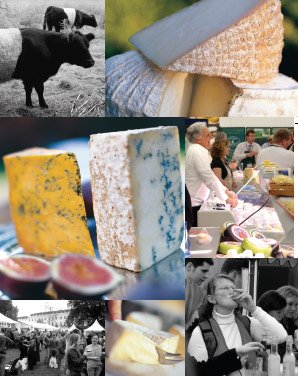
British Cheese Festival

Whatever your age, shape or style there is something for everyone. So join thousands of food lovers from around
the world for Britain´s Biggest Cheese Show and discover more than:
450 cow, sheep, goat & buffalo cheeses to taste and buy from over
100 cheesemakers in BRITAIN's BIGGEST CHEESE MARKET
50 British food & drink producers
40 masterclasses & cheese demonstrations
36 English wines, real ales, lager & ciders all makes
1 sensational day out in Cheltenham - whatever the weather

This event will take place on Saturday September 30th &
Sunday October 1st, 2006 in Montpellier Gardens, Cheltenham, UK.

For more information click here>.

Here comes the Judge

Imagine this. The unceasing cacophony of barking dogs and sunrise-shift chickens…the incongruous smells of cow manure and hot bread. It’s judging day at the Ferny Flats Annual Cake Show.

Of course the exact location of Ferny Flats remains untellable, but the way it prepares for its annual display of excellence and pride in its cookery prowess is echoed uniquely in countless country towns throughout Australia.

The label ‘cookery exhibition’ is one of the great understatements. They are not just displays of cakes. They are events of great consequence, of great personal achievement, of massive civic pride – staged with equal parts of drama, human exertion, passion, tragedy, and of course, comedy.

The ‘need to win’ at the Ferny Flats Annual Cake show is no less challenging to the entrants as it is for any event in the Olympics. A blue ribbon is a personal triumph – and a victory for the town. Anything less is unacceptable.

Which all adds to the imponderably difficult job of the Judge – the ‘out-of-towner’ who might topple the social standing of the best known Country Lady with a single bite of a lamington.

The criteria for judging cookery may seem logical and relatively simple. The ‘best cake’ must have the best appearance, the best texture, the best smell and the best taste. And a good judge with real ability and experience can always pick a winner.

To understand the business of cookery judging, you should know a little about the beast. Cookery shows can be held by almost anyone or any organization - scout groups, retirement homes, dandelion appreciation groups, waterside workers, and of course, most Royal Agricultural and Horticultural Societies.

In every case, there is an organizing committee usually made up of a president and vice president, a secretary, a treasurer, a publicist, someone who knows how to fix the photocopy machine, and a person to make the tea. Cookery contests take months to devise, plan and prepare. The right venue (usually in a large unventilated tent very close to a lot of animals on a muddy road with no parking and not enough public toilets).

Then there’s the judge and her/his team. Generally speaking, the judge is invariably on the ‘pretty-well-known’ list, and will know exactly what to look for. With the Judge will be one or two ‘Judging Stewards’ In some country shows, these stewards were former judges of itty bitty exhibitions. They had the knack of always winning in the section they judged. Even as my steward/assistant, they had a way of getting their own entry fair and square right under my nose.

The real job of the Steward (or Assistant Judge) is to assist. To help the Judge get to the finalists by eliminating the entries which don’t really have a chance. But most Stewards seem to be there to eat. Not just a sliver, a morsel, a collection of crumbs, but everything. There have been times when I would return to, say, a lamington – to find no more than a few crumbs on the plate. It had been ‘tasted; by the stewards, who explained they were comparing theirs with my palate.

Stewards are usually not thin people. They do not generally excel in the art of conservative tasting. At large country shows, they appear to have an ability to clear a table of cakes not unlike a large industrial vacuum cleaner.

Even after hours of food tasting, when all you crave is a cuppa, the Stewards will lead you off to the morning tea – a virtual orgy of cream cakes, scones, loaves, sandwiches and other ‘judging cut-offs’.

The committee, however, is a deadly serious body. Hell-bent on success for the town, they assemble for the all important Annual meeting.

The place, the date and the time is selected, rejected, amended, resubmitted and adopted, and the word goes out. Ferny Flats is having a Cake Show.

Usually quiet – even on New Year’s Eve – the little town shifts into full-ahead. Mrs. Heeps buys in special flour from another suburb. Narelle (on the corner) postpones the Bridge afternoons for a month and starts to prepare for another batch of her famous rhododendron scones.

There are, of course, cake makers who are born to win. They are the true champions…the ones with the culinary equivalent to the gardener’s green thumb. And then there are the others.

Take for starters the architecturally perfect lamingtons I faced last year at a little New South Wales Country show. Nothing wrong with the color and overall appearance, but it was their precise shape that grabbed my attention…until the taste test. Nobody had told the maker that the judge would taste them. Beneath the layer of coconut and chocolate were carefully carved 2 x 2 blocks of Velvet Soap.

Another memorable example of deception was at a show in Central Victoria when one of my stewards broke a denture on a piece of shortbread – a test which proved very quickly that it was not the ‘melting moment’ it was claimed to be.

Surprises must be handled with equal parts of tact, diplomacy and courage…as was the case during bread judging at a well staged show at a small South Australian town. The final decision was between two entrants. One golden brown, crusty creation was lifted for a closer inspection…to reveal a small mouse baked into the bottom of the loaf.

The Blue Ribbon First Prize…whether it is trophy, sash or hamper, is always accompanied by the certificate. While winning one is a public bathe in glory, the real agony must surely be to ‘just lose out’. Second place is no reward for dedication, toil and heartache that goes into the preparation of so many of the entries with which I have been confronted.

I remember vividly the stressed looking husband at a cake show near Sydney as he made his way delicately to the judging table, carrying an elaborately iced wedding cake complete with delicate handcrafted roses and oh-so-fragile extension piped icing. Just as he was about to place the top tier onto to the ‘Eiffel Tower’ creation, he tripped…right into the cake. Destruction was immediate. Attack from his wife was just as swift. Hurling chunks of broken cake, pillars and roses at her retreating husband, she screamed to the judge: ‘well, you saw it before he got to it…judge it from what it was’. There was no way out. Mrs. Eiffel Tower received a hasty ‘Highly Commended.’

Bad decisions, too, are always possible. In Perth for a special competition to track down the best of 2100 fruit cakes, I was met at the airport by a colleague writer who wanted an opinion on her own cake before she decided to enter the marathon. It was somewhere between awful and horrible, and I told her not to enter. Many years later, the same person became my editor.

The contest was certainly special. The hall was a mountain of fruitcake. All made from one recipe, from which a staggering 2100 variations had been created. Creative genius there was, sprinkled with a generous dash of the God-forsaken. Cakes with crusts of pure charcoal, some in plastic bags, still warm and sprouting mould, some with rancid dairy ingredients, others smashed in transit into a million crumbs. As they say, the Show must go on, and it did.

Did someone dare suggest bribery and corruption…in a Cake Show? It is true there have been many ‘If I don’t win, I’m sunk’ sort of conversations before a show, but as you don’t know the entrants until presentation time, there is precious little chance for the heavies in this game. It’s also true that any judge worth her or his taste buds will stay at a very inconspicuous hotel and give their telephone numbers to nobody.

Still, those hell-bent on bribery will stop at nothing. I can never forget Ricky, the kid who pinned a note under his entry telling me the following: a) he was 12 years old. b) He was very good looking, and c), that he would split his winnings with me. What a chance for me! I replied on the same note with a question for Ricky…did his father cook?

Hints for aspiring cookery judges? Apart from the experience you need, there are a few other requirements if you want to make it to the next show: A Hard Hat, a Cast Iron Stomach, Sharp knives (no, for the cakes), a sense of humor, and an unlisted telephone number.

Kate McGhie
Vice Chair
Australia

Sunday, July 30, 2006

Global Food Reports

Global Voices Online - The world is talking. Are you listening?


Check out Melissa De Leon´s latest Global Food Reports on Global Voices which include valuable links to food websites and podcasts from Malaysia, Sweden, Spain, and Venezuela among others.

  • Global Food Report #25

  • Global Food Report #26
  • Frankfurt Book Fair – October 4-8, 2006

    For the first time an international exhibition of food and wine books will take place at the Frankfurt Book Fair. There will be 1500 books of the last 10 years, from 70 countries. The exhibition takes place on the Gourmand World Cookbook Awards stand, with 150 m2, and shows the winners of last year awards, as well as a selection of winners from the past years.

    Since the announcement of this exhibition, authors and publishers of food and wine books have communicated to Gourmand that they will visit the Frankfurt Book Fair, many for the first time. Gourmand maintains a list of these visitors. Many meetings have been already arranged, and there is intense activity.

    The “Gourmand World Cookbook Awards” were created at the Frankfurt Book Fair in 1995 to honour those who cook and drink with words. Since then the sector has had amazing growth, with the help of television, and has become glamourous, with stars in many countries. The number of titles published each year has at least doubled in 10 years in most countries. For instance Sweden publishes now the same number of titles as France ten years ago, with a population 6 times smaller. France has multiplied in 10 years its production by nearly 3 times. Now Asia and other markets are developing rapidly.

    The “Gourmand World Cookbook Awards” have become the “Oscars” of the sector. They have taken place in Germany, France, Spain, Sweden, and for the first time in May 2006 in Asia, in Kuala Lumpur, Malaysia. So Gourmand is very pleased to come back to the Frankfurt Book Fair this year, and honour there again its past winners with this exhibition.

    For Information visit the Gourmand website or contact:

    Edouard Cointreau, President, Founder
    Pintor Rosales, 36
    28008 Madrid
    Spain
    Tel: +34 91 541 67 68 Fax: +34 91 541 68 21
    E-Mail: edouard@gourmandbooks.com

    Bo Masser, Secretary of the Jury
    Brandtvagen 5 A
    SE-712 32 Hellefors
    Sweden
    Tel: +46 70 6677 388
    E-Mail: bo@massers.se

    www.cookbookfair.com

    Tuesday, July 18, 2006

    Dia de las Ciruelas - Slow Food Laboratorio del Gusto

    The invitation had come for the 51st Laboratorio del Gusto in Mexico City and I had quickly accepted. As an expatriate “foodie” the invitation program was irresistible. Picking plums and preparing recipes with Chef Olivier Lachevre, sipping organic Veracruzan coffee, followed by a Carne Asada luncheon prepared by our host Sergio Ynurrigarro in the gardens of the House of the Sun and Moon. All that was needed were directions and Sergio’s encouraging words “just keep driving until you see the Slow Food posters and then turn right”.

    As we left the valley floor of the city and slowly drove up the mountainside on the Camino al Desierto de los Leones my friends and I anxiously scanned every corner for the non-existent street signs and realized it was the road markers we would need. Km. 30 was our destination and we were only at Km. 18 when the grainy hail and rain started to fall. It was Sergio with umbrella and hand signs that finally welcomed us. The cafe de olla was warm, sweet and dark a perfect antidote to the chill breezes of the overcast morning.

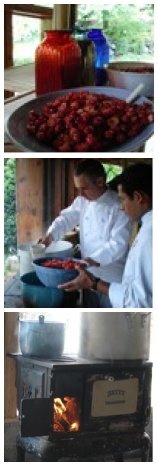
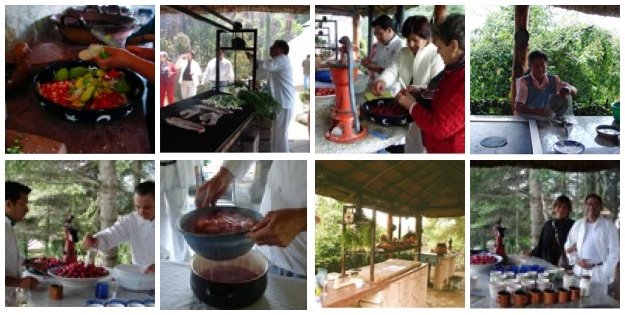
    As our fellow foodie compatriots arrived, we were delighted by the tour of the orchards and specially the palapa where a 6 foot parilla ladened with scallions, tomatoes, chiles, and avocados were ready and waiting for Sergio to begin, but not until we gathered at the 2nd terrace meeting room/palapa did we begin with the fresh plums and their transformation into jam, jelly and the flavoring for plum wine infused with Mezcal.

    Aromas of sweetened plums, sharp onions, coriander, grilling steak had our primal emotions stirring. As a group, we took the cobbled path to the grill and watched as the gnarled hands of an expert tortilla maker took the blue corn masa, formed, pressed and then quickly threw the tortilla on the grill to cook. Sharp pungent flavors, green and red chile salsas, the cooling unctuous flavor of guacamole, carne asada and the scent of mountain chill, culinary bliss !


    Our Laboratorio del Gusto was ending but not the memories of taste of El Dia de las Ciruelas.

    Ruth Alegría
    Mexico

    Saturday, July 15, 2006

    Madrid Fusion 2006 goes to New York City


    The French Culinary Institute in New York City, winner of IACP´s School of the Year Award 2006, is celebrating it´s new home, the International Culinary Center, this coming October. And what a way to celebrate! During two days, the new center will be hosting culinary demostrations by 10 of the most prominent Spanish chefs, including Ferran Adriá, Juan Mari Arzak and Martín Berasátegui. If you missed Madrid Fusión 2006, now is your chance for this unique experience.

    For more information visit Spain´s 10.

    Wednesday, July 12, 2006

    Projeto Mandioca

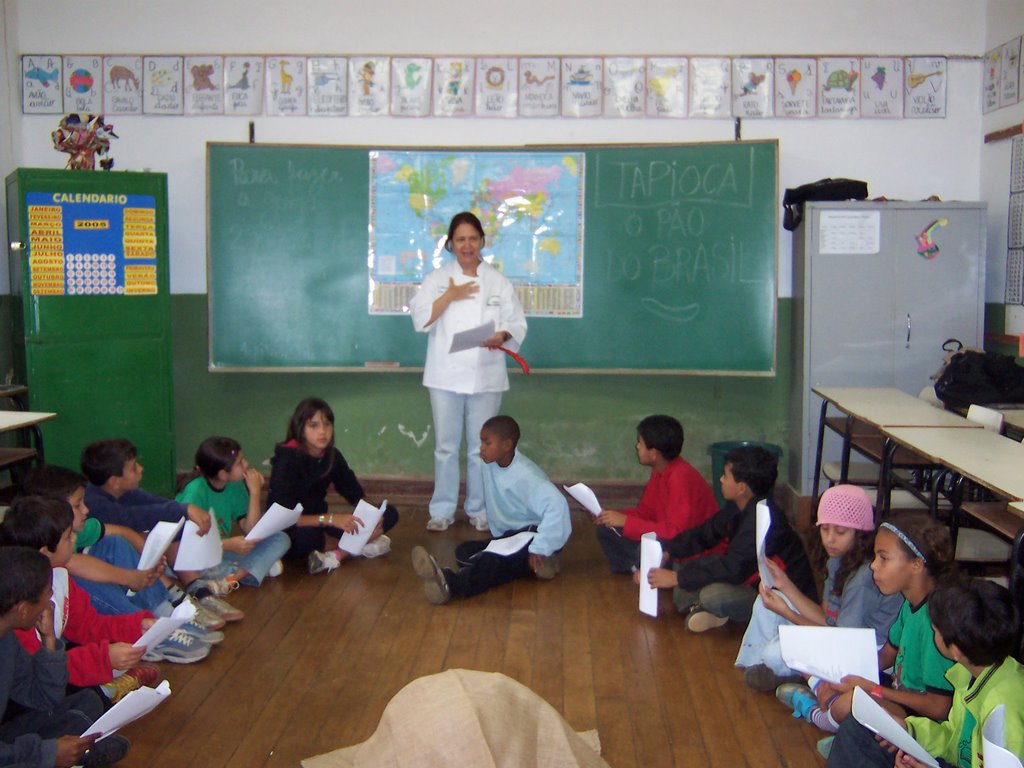
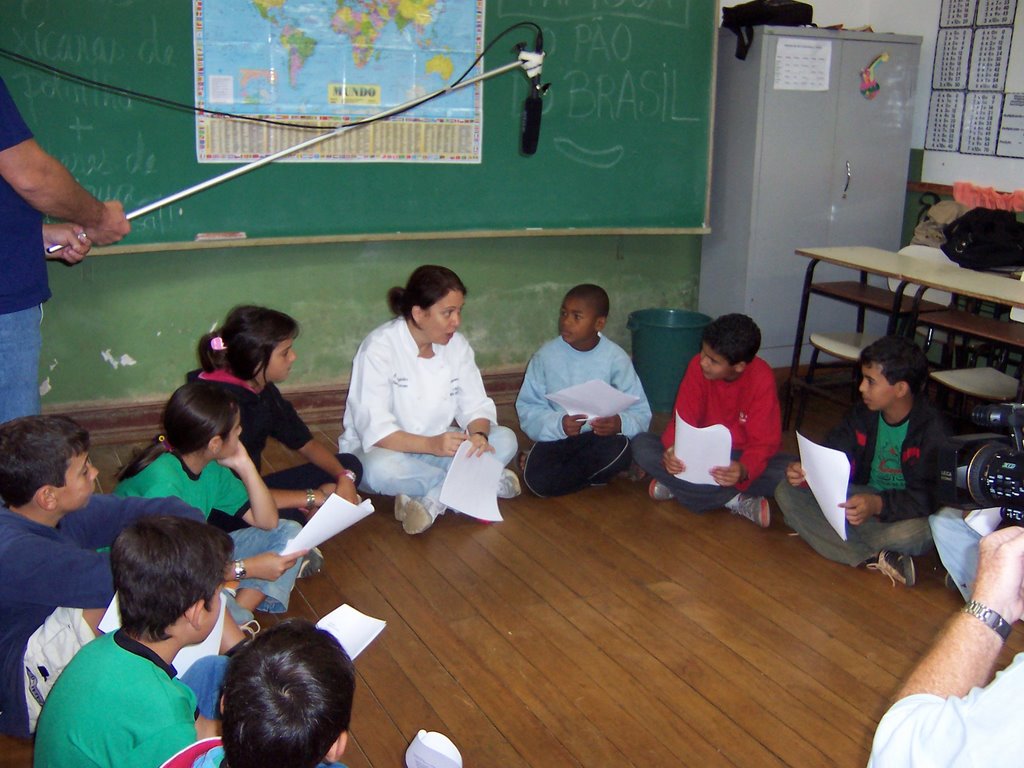
    Since October 2002, children attending public schools in the city of Rio de Janeiro are having the opportunity to learn more about Brazil’s food history and habits through “Projeto Mandioca”, a project developed by Teresa Corção, chef/owner of restaurant “O Navegador”, in downtown Rio.

    For over 25 years in food business, Teresa believes that the project will help children to better appreciate their own families’ culinary treasures, as well as to enhance their interests for the products, tastes and aromas of the Brazilian culinary.
    “Manioc was and still is Brazil’s bread since the times when the Portuguese colonizers had not yet arrived to these lands.
    As a major source of carbs, manioc provides the energy needed to face hard works, and can be considered as the “blood of Brazilian land”, reminds Teresa.

    The real importance of this product is mostly unknown, although it is very much used and appreciated in our daily meals. In the very first contacts that the discoverer of Brazil – Pedro Alvares Cabral – had with the Indians Tupiniquins, in the south of the state of Bahia, he was introduced to manioc, a native product of those yet unexplored lands.
    To our native Amerindians, manioc was the most important ingredient in the preparation of different meals such as porridges, cakes, breads (pirão, beiju, mingau ,paçoca).

    As the European wheat was not suitable to the climate of the newly discovered lands, the colonizer had to get used to manioc, a root so much appreciated nowadays throughout the world.

    No other product is as much Brazilian and has such an importance as manioc.

    With this in mind, and working together with a team of experts Teresa decided to launch her project. Through workshops in public schools, children learn the importance of manioc during informal classes, theater and hands on cooking demonstration, learning how to prepare tapioca and other traditional Brazilian dishes. This way they strengthen their relationship with their Brazilian identity.


    Projeto Mandioca has been supported by EMBRAPA - Empresa Brasileira de Pesquisa Agropecuária (Brazilian Agroindustry Research Company).

    This organization maintains Projeto Mandioca permanently updated in whatever concerns manioc in Brazil and worldwide, while improving its research studies on the subject.

    VIVA A MANDIOCA !

    Did you know that...

    1-Over 4 million Brazilians depend directly or indirectly of manioc culture
    2- The very first Brazilian Constitution was called “Constituição da Mandioca” that is Manioc Constitution, thus showing how much manioc symbolizes to our national identity
    3-Manioc sediment (fecula) is a powerful starch very much used in industry such as pharmaceutical, textile, pulp and paper industries besides many different uses in food industry
    4-Manioc leaves have high concentration of calcium, iron, vitamin A and proteins. A preparation with the dehydrated and powdered leaves is being distributed to low-income population in the country.
    The Ministry of Health as the most important ally against sub nutrition is considering this action.
    5- The state of Pará is the most important producer of industrialized manioc meal while the state of Bahia is the larger artisan producer of manioc meal.
    6-There is a project going on at the Deputy Chamber, which tries to include or substitute part of wheat flour for manioc flour in the preparation of daily bread and other preparations. Embrapa is researching if this would improve the protein values on the bread presently consumed in Brazil
    7-Nigeria is the world largest manioc producer; our Portuguese colonizers took this native Brazilian root there
    8-Thailand, which also received the root from our Portuguese colonizers, is the largest worldwide exporter of manioc starch mostly to European Union.
    It is interesting to notice that manioc is not used there as food.
    9-Brazil has a surplus of manioc starch (fecula), which has rendered useless because its exports are not competitive in the European Union.
    Thailand, which is the largest exporter, enjoys a zero tax bracket, while our product is charged by a tax above 20%.
    10- Brazil produces 23 million tons manioc behind only to Nigeria whose production is of 34 million tons.


    Projeto Mandioca
    Teresa Corção
    IACP Country Coordinator
    Brazil

    Sunday, July 09, 2006

    Kyoto's Nishiki Market

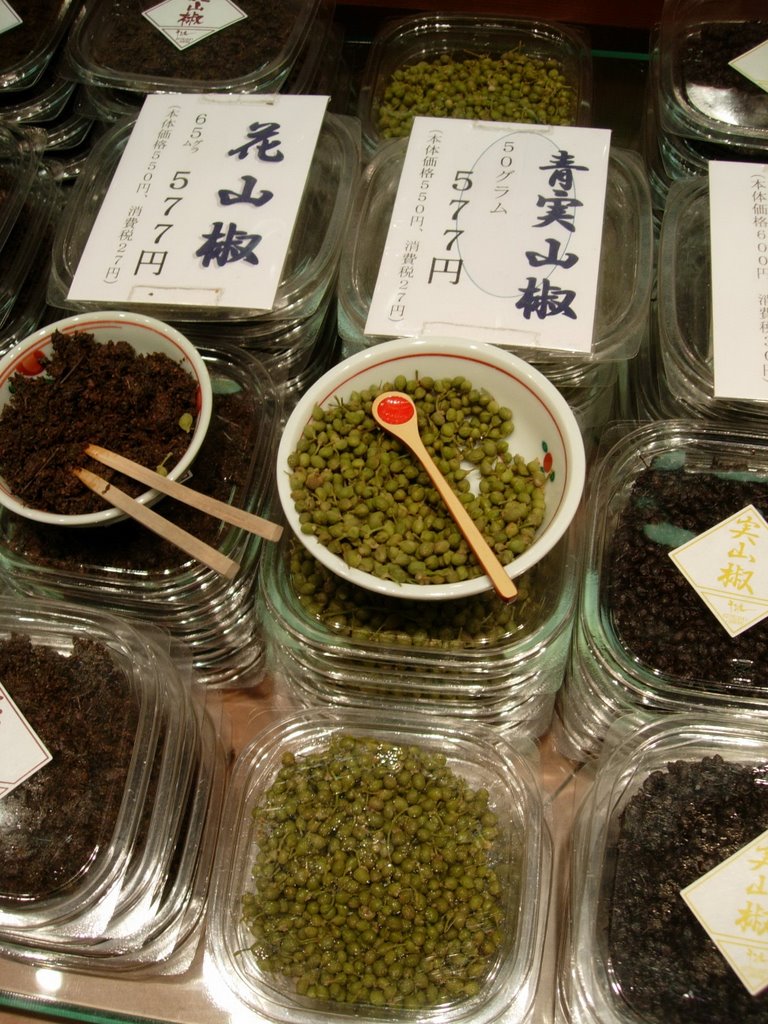
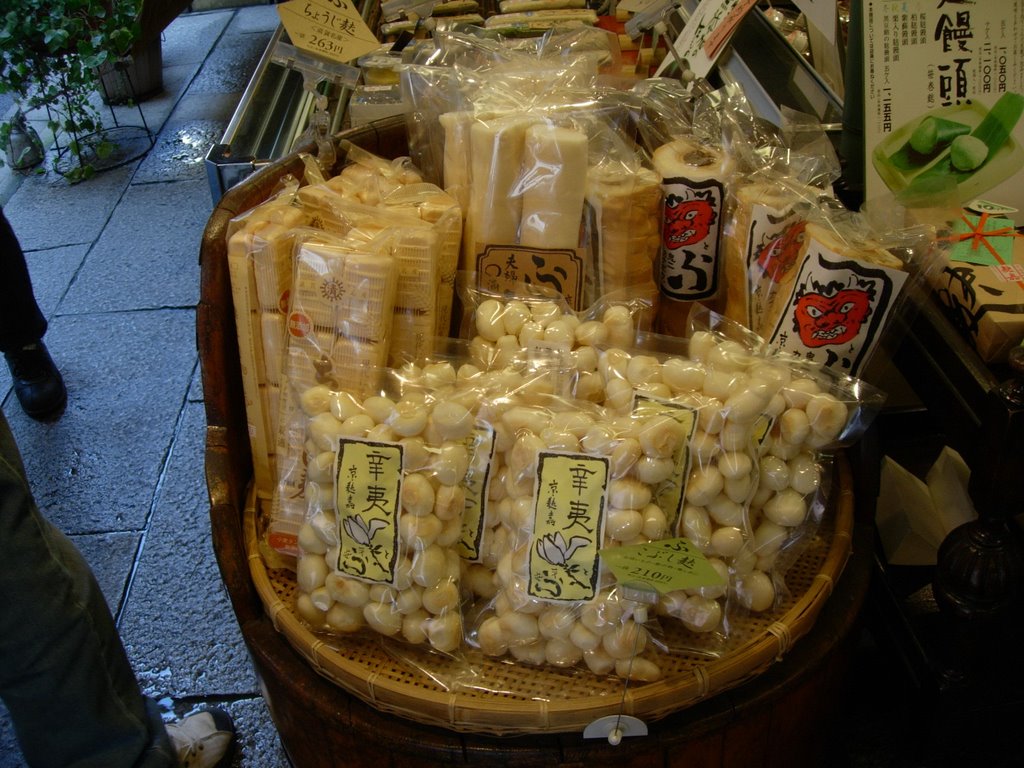
    Nishiki Market is in the heart of the historical city of Kyoto. It is open to the public and you will find most of Kyoto`s famous food products here from yuba (soy milk skin) to tsukemono (pickles) to ocha (tea). The Aritsugu knife shop offers more than a huge selection of knives but also a variety of kitchen tools. A new addition to the market is a standing bar where you can have fresh oysters and wine. Do not miss the Photo Tour and Yukari's list of favorite shops.


    by Yukari Pratt
    Tokyo, Japan